Insite — Decision Support

If you need a sponsor-ready view of your current exposure and the path to a defensible pack:

Packs (choose one, or combine)

Mining Charter Submission Pack (MCSC)

Deadline: submission due on or before 31 March each year.

Scope: Mining Charter is done by Mining Right. Typical footprint is mine + core contractors + community. Outcome: a Mining Charter pack leadership can defend, with pack provenance and exception closure status.

SLP Reporting Pack

Cycle: annual reporting (timing varies by mine).

Scope: scoped by Mining Right and contractor footprint. Outcome: controlled SLP reporting outputs with clear ownership, traceability, and exception closure status.

B‑BBEE Pack

Cycle: annual measurement/verification (timing varies by company/measured entity).

Scope: scoped by measured entity/company (Generic and/or Construction Charter). Outcome: defensible scorecard outputs with an evidence + exception closure trail and clear ownership.

Integrated baseline (reuse across MC + SLP + B‑BBEE)

If you’re tired of rebuilding “truth” three times, start with a defensible baseline and reuse it across Mining Charter, SLP and B‑BBEE.

Outcome: a single controlled baseline that prevents rebuilding “truth” three times.

What you get (explicit board artefacts)

In the first 4 weeks (from kickoff)

A board‑ready pack for the selected reporting pack (Mining Charter / SLP / B‑BBEE), including:

  • Pack outputs (scorecards/tables as required)
  • In‑system traceability (drill‑down to contributing records; report, extract date, rule/logic)
  • Exception closure list (gaps/anomalies + owner + closure status)
  • Approval pages per section/metric set (signature pages)
  • Pack provenance (scope, period, reports used, extract dates, data quality position)
  • Board summary (key risks, assumptions, readiness status)

Every month (12‑month readiness control)

  • Readiness snapshot (RAG / completeness / accuracy flags)
  • Exception closure with owners and due dates
  • Evidence expiry radar (what will fail in the next 60–90 days)
  • Audit‑ready pack provenance (scope, period, reports used, authorisations)

Implementation (how you get to first value quickly)
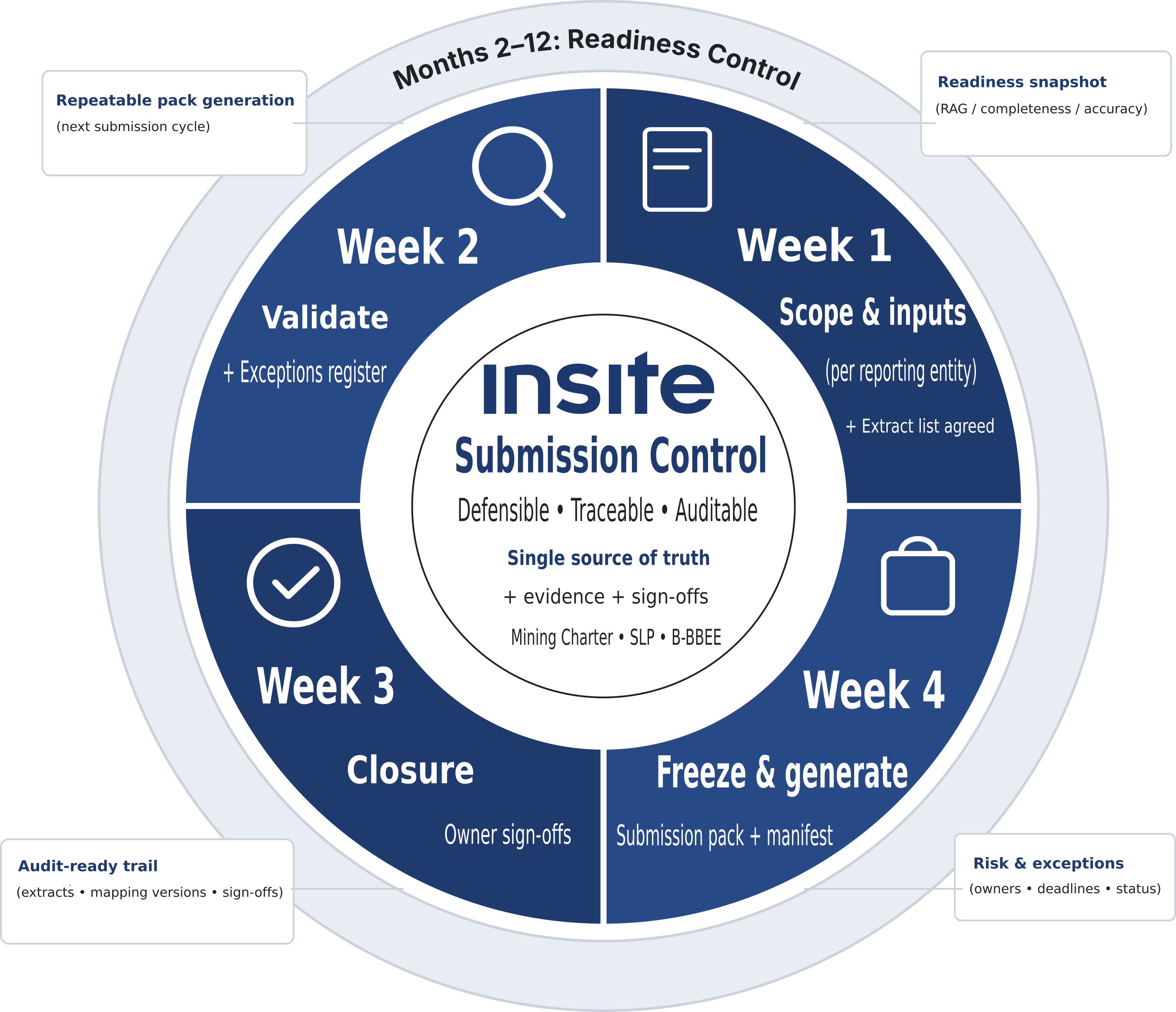
Insite submission control wheel

Weeks 1–4 (first defensible pack)

  • Week 1 — Controlled inputs: confirm scope (pack + footprint); agree extract/report list; ingest first inputs (manual extracts or API pulls)
  • Week 2 — Validation: reconcile and validate; publish exception closure list with owners and due dates
  • Week 3 — Closure + approvals: close exceptions; authorise final production imports; hold release review/approval; document accepted assumptions
  • Week 4 — Final pack: freeze dataset; generate final pack, pack provenance, audit trail, and board summary

Months 2–12 (readiness control)

  • Monthly readiness snapshot + exception closure
  • Audit‑ready record of decisions and changes
  • Repeatable pack generation for the next cycle

Data quality (defensible numbers, without spreadsheet hacks)

Most mines can’t fix upstream data quality overnight. Under deadline pressure, teams end up “patching” extracts in spreadsheets — creating one‑off versions of the truth that are hard to repeat, hard to govern, and hard to defend.

Insite takes a different approach: it gives you an import staging step where repeatable fixes and enhancements can be applied consistently (mapping/alignment, standardising codes, controlled derivations where the rule is defensible). If there’s an auditable path from “what the source system gives you” to “what the pack requires”, Insite applies it the same way every cycle, so you don’t have to rebuild logic in ad‑hoc spreadsheets, and you may not need urgent base‑system changes for that class of issue.

Some issues still need to be fixed upstream (missing capture, process gaps, master‑data discipline, tagging, and evidence realities), and those changes take time. Insite quantifies data issues and makes their impact on the reported figures explicit, so leadership can declare the trust position and limitations with the pack, and withstand audit/verification scrutiny. Teams then drive closure through exception closure (owners + due dates) without hiding workarounds in spreadsheets.

Read more

How Insite makes data quality a measurable control layer so the numbers you submit are defensible.

Data quality is how Insite makes reporting defensible

FAQ

No. Many mines aren’t “tech ready” on day one. We can start from manual ERP extracts to establish ownership and cadence, then move to scripted aggregation or API pulls once deadline risk is contained.

No. We deliver productised control outputs: traceability, exception closure, data import authorisation, pack provenance, and pack outputs — not bespoke advisory reports. Final release review/approval of exported figures is a governance step outside Insite. Consulting rates apply only to explicit scope expansion (extra sources, entities, contractors, or custom transformations).

No. Your ERP remains your system of record. Insite becomes the compliance control layer across systems and owners.

Mining Charter is scoped by Mining Right. A typical Mining Right includes the mine, core contractors, and community entities. Additional contractors are scope expansion.

SLP is scoped by Mining Right and the contributing contractor footprint. A typical Mining Right includes the mine, core contractors, and community entities.

B‑BBEE is scoped by measured entity/company (legal entity), not by Mining Right. We confirm whether scope is Generic and/or Construction Charter in Week 1.

What Insite covers (the baseline you reuse)

Insite is designed to collect, validate and govern social compliance data across the operational domains that drive Mining Charter, SLP and B‑BBEE reporting:

Human Resources / People
Training / HRD
Procurement
Community Development

Security and governance

What’s new

Resources

Explore practical content on:


Support:

Scope & pricing (quoted by footprint, not seats)

Pricing scales with your footprint and complexity. Quotes are based on:

The pack is included for an in‑scope footprint as part of the 12‑month readiness control. Scope expansion (extra sources/entities/contractors) is quoted separately.

Get the Sponsor Decision Memo / Book a Readiness Review

If you want a sponsor‑ready view of your current exposure, choose the option that matches your next step. Already a customer? Login here .

Option A — Get the Sponsor Decision Memo (PDF)

Choose the memo that matches your cycle (SLP / Mining Charter / B‑BBEE / Combined). The memo is designed to be forwarded internally to a board‑weight sponsor.

Email instead

Option B — Book a 30‑minute Readiness Review

Confirm scope and identify the fastest path to a defensible first pack (and a 12‑month readiness control).

To scope quickly, include:

  1. the reporting pack you need (Mining Charter / SLP / B‑BBEE / Combined)
  2. number of Mining Rights (Mining Charter / SLP)
  3. number of core contractors (Mining Charter / SLP)
  4. your measured entity/company (B‑BBEE)
  5. your ERP(s)
  6. headcount Mine + Contractor(s)
Email instead

Who is the Sponsor Decision Memo for

Board / Exco / Risk Committee sponsors

Sponsors who own approval decisions and reputational / licence‑to‑operate exposure:

  • COO / GM / Operations leadership
  • CFO / Finance leadership (assurance framing)
  • Company Secretary / Governance / Risk
  • Internal Audit / Assurance

Champions

Champions who feel the pain first (and need sponsor cover to fix it):

  • Social performance / social compliance
  • Risk department
  • Data owners across HR (People), HRD (Training), Procurement, Community Development
Sponsor test If these are hard to answer, you’ll stall.
  • Who presents this to Exco/Board Risk?
  • Who signs off the figures as defensible?
  • Who owns the risk when audit asks “show me”?